
Modeling & Inference
Estimate unknown quantities from complex data using model-based and probabilistic methods.
TS-Analytics develops and applies signal processing methods for technical and scientific data where raw signals need to be cleaned, transformed, characterized, and interpreted.
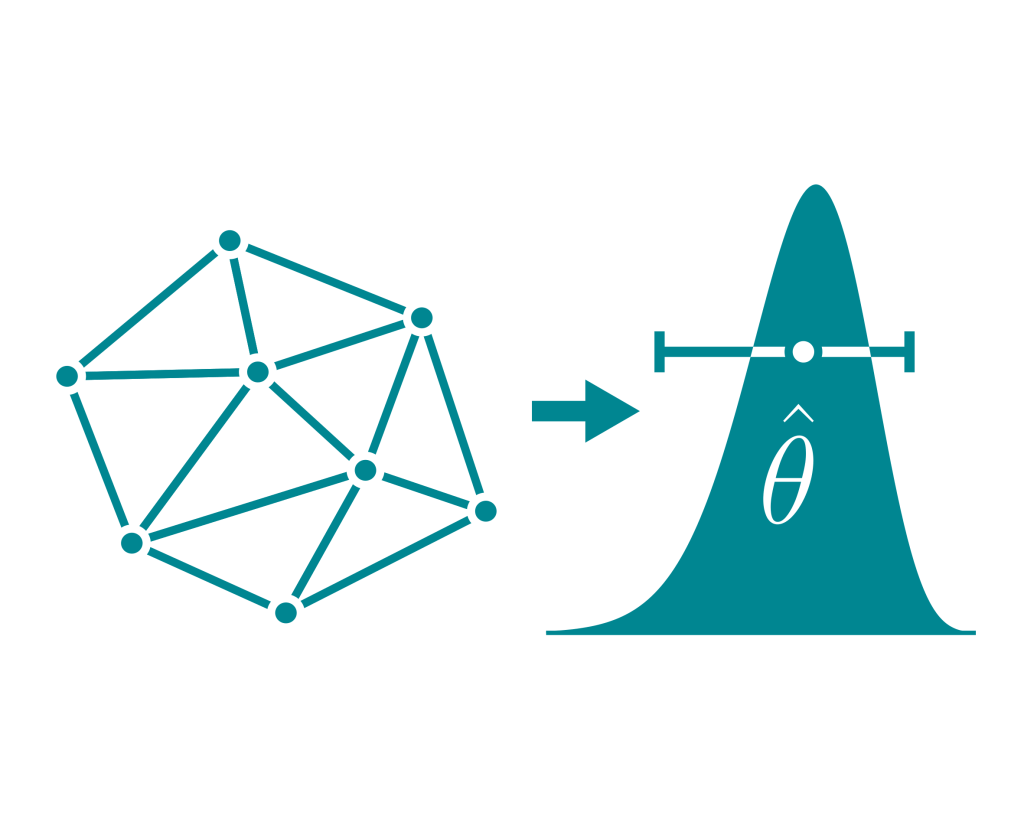
Estimate unknown quantities from complex data using model-based and probabilistic methods.
TS-Analytics develops and applies signal processing methods for technical and scientific data where raw signals need to be cleaned, transformed, characterized, and interpreted.
Typical project situations
Modeling and inference are relevant when the quantities of interest cannot be observed directly and need to be estimated from data, models, and assumptions.
Typical situations include:
- Parameters or system states need to be estimated from measurement data
- The available data are indirect, noisy, incomplete, or high-dimensional
- Physical, statistical, or domain-specific knowledge should be incorporated into the analysis
- Inverse problems or ill-posed estimation tasks need to be formulated and solved
- Uncertainty in estimated quantities needs to be evaluated and interpreted
What TS-Analytics can provide
Modeling and inference support can range from focused parameter estimation tasks to complete probabilistic modeling workflows for complex technical or scientific data.
Typical tasks
- Parameter estimation
- System-state inference
- Bayesian and probabilistic modeling
- Inverse problem formulation and solution
- Model interpretation and uncertainty evaluation
Typical deliverables
- Implemented model or inference algorithm
- Parameter or state estimates with uncertainty evaluation
- Documented model assumptions, estimation results, and limitations
Example applications
Parameter and state estimation
Estimation of unknown model parameters, system states, or hidden variables from noisy measurement data using statistical, probabilistic, or model-based approaches.
Inverse problems
Formulation and solution of inverse problems where hidden quantities must be reconstructed from indirect measurements, sensor data, or model outputs.
Probabilistic interpretation
Development of probabilistic models that quantify uncertainty, incorporate prior knowledge, and support interpretable inference from complex datasets.
Related services
Modeling and inference often connect signal processing, statistical analysis, and automated workflows into a coherent analytical approach.
Signal Processing →
For preprocessing, feature extraction, and preparation of measurement or time-series data before modeling.
Statistical Analysis →
For uncertainty evaluation, model comparison, performance assessment, and interpretation of quantitative results.
Automated Workflows →
For reproducible implementation of models, inference algorithms, simulations, and repeated analyses.
Need Support with Model-Based Analysis?
Get in touch to discuss how TS-Analytics can support parameter estimation, probabilistic modeling, inverse problems, or uncertainty-aware inference.
Free initial call · NDA possible · Remote collaboration across AT/DE/EU